From Compact to Modular: Choosing the Right PLC Architecture
By Kiran Kothmire, Senior Automation Specialist, Anadi Automation
As automation engineers, we know the Programmable Logic Controller (PLC) is the heart of every industrial system. But asking “Which PLC should I use?” is like asking “Which car should I drive?”—the answer depends entirely on the application.
Choosing the wrong PLC type can lead to unnecessary complexity, limited future scalability, or a cost overrun on a tight budget. Our goal at Anadi Automation is to ensure your production is robust, scalable, and optimized from day one.
Here is a practical breakdown of the different PLC architectures and when we use them in the field.
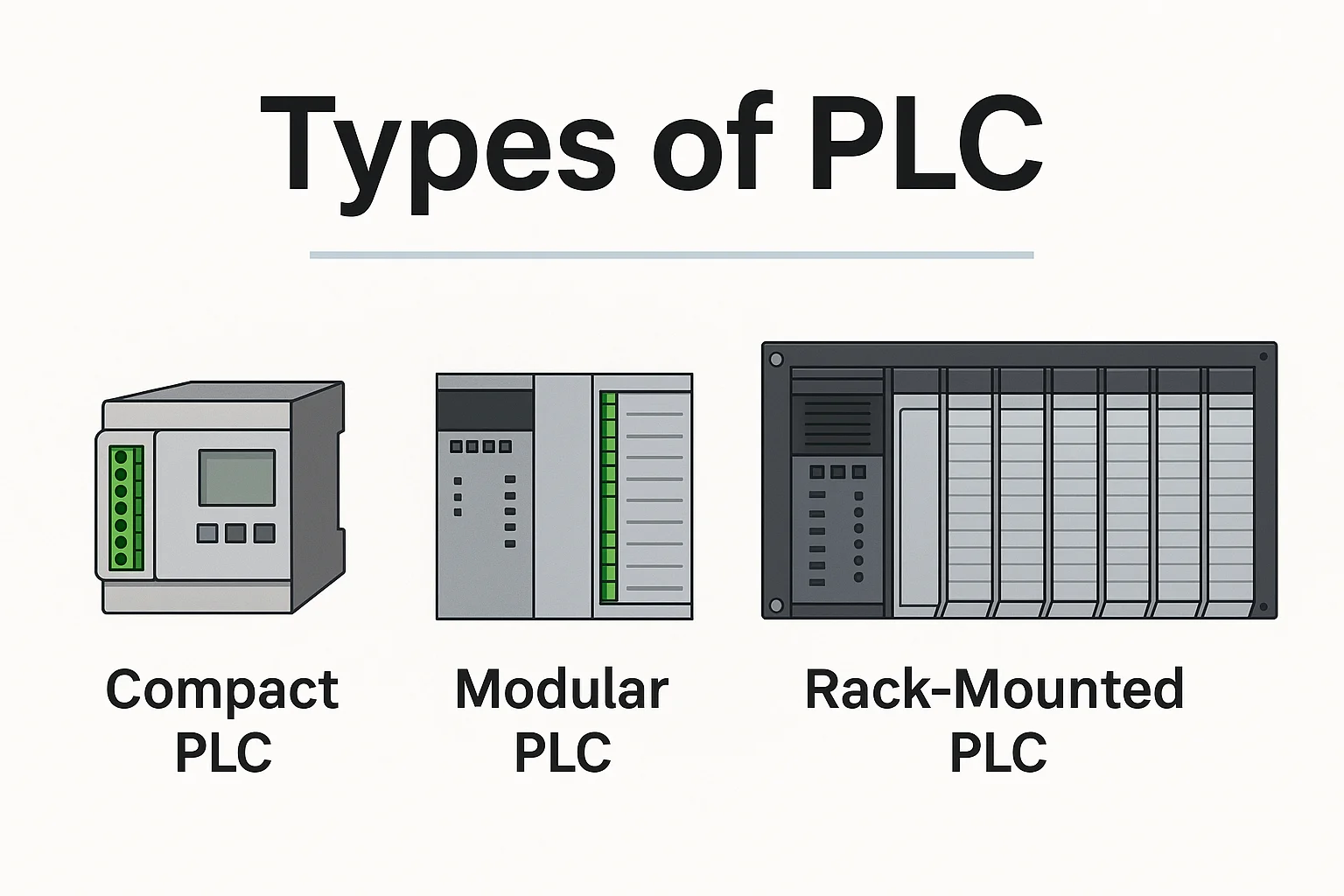
1. The Compact (Fixed) PLC: The Workhorse for Small Systems
The Compact PLC, sometimes called the “Brick” PLC, is the simplest and most cost-effective option.
Architecture
The CPU, power supply, and a fixed number of Input/Output (I/O) points are housed in a single, non-modular unit. While some models offer limited expansion modules (often 2–4 modules), the core functionality remains fixed.
Practical Applications (When to Choose)
Small, Standalone Machines: Perfect for controlling a simple pump station, a conveyor segment, or a basic packaging machine where the control requirements are clearly defined and unlikely to change.
Low I/O Count: Typically used for applications requiring less than 64 I/O points.
Cost Sensitivity: When budget is the primary constraint and the application is straightforward.
| Pros | Cons |
| Low Initial Cost and minimal panel space. | Limited Scalability for future needs. |
| Simple Installation with no need for a backplane/chassis. | Fixed I/O Types: Cannot easily mix and match specialty I/O cards. |
| Faster Scan Time due to the integrated design. | Lack of Redundancy options fo |
2. The Modular PLC: Power and Scalability for Complex Operations
The Modular PLC is the standard for almost all large-scale, mission-critical industrial processes.
Architecture
This type uses a chassis or rack where the components are separate, interchangeable modules:
- Rack/Chassis: Provides the physical structure and the backplane (the high-speed internal bus).
- CPU Module: The processor itself.
- Power Supply Module: Powers the backplane and all other modules.
- I/O Modules: Slots for digital, analog, and specialty cards (like motion control).
Practical Applications (When to Choose)
Large Manufacturing Lines: Ideal for automobile assembly, large batch processing plants, or complex material handling systems.
High Scalability: When you know the system will grow or need future upgrades to I/O or processing power.
Process Criticality: Used when high availability, redundancy (dual CPUs, redundant power supplies), and advanced diagnostics are mandatory.
Specialty Control: Required for applications involving high-speed motion control (servo drives), complex temperature control, or cybersecurity integration.
Engineering Insight: The key value of the modular system is its hot-swappability. If an I/O card fails, a technician can replace it without powering down the entire chassis, drastically reducing downtime.
3. The Distributed I/O System (Rackless/Remote)
While not a PLC itself, Distributed I/O is a critical modern architecture that works in conjunction with Modular PLCs.
Architecture
I/O modules are removed from the main PLC cabinet and placed closer to the field devices (sensors, valves, motors) on the factory floor. They communicate back to the main Modular PLC (the controller) via a high-speed industrial network like PROFINET or EtherNet/IP.
Practical Applications (When to Choose)
Large Geographical Footprint: Essential in expansive facilities (e.g., refineries, water treatment) where running hundreds of individual wires back to a central cabinet is impractical and expensive.
Reducing Wiring Costs: It replaces hundreds of copper wires with a single, high-bandwidth Ethernet cable.
Harsh Environments: The remote I/O blocks can be IP-rated (e.g., IP67) and designed to withstand dust, moisture, and high temperatures better than standard cabinet I/O.
Making the Right Choice: An Engineer’s Checklist
When designing an automation solution, we use a simple checklist to match the application to the PLC architecture:
| Factor | Low I/O / Simple (Choose Compact) | High I/O / Complex (Choose Modular/Distributed) |
| I/O Count | Less than 64 Digital/Analog points. | Greater than 128 points, or requires specialty I/O (e.g., vision, high-speed counters). |
| Response Time | Cycle time in the tens of milliseconds is acceptable. | Requires sub-millisecond scan time (e.g., motion control, high-speed press). |
| Future Growth | Zero anticipated expansion or changes. | System is expected to scale by 20% or more in the next 5 years. |
| Physical Space | All field devices are located within 20 meters of the central cabinet. | Devices are spread over a large factory floor (requires Distributed I/O). |
| System Uptime | Failure is an inconvenience (e.g., can wait 30 minutes for a restart). | Failure is catastrophic (e.g., requires dual-CPU redundancy and high-speed diagnostics). |
Partner with Our Multi-Brand Experts
Understanding these architectures is the difference between a system that works and a system that excels.
At Anadi Automation, our expertise spans across all major PLC manufacturers, including Siemens, Allen-Bradley (Rockwell), Mitsubishi, and Schneider Electric. This vendor-neutral knowledge allows us to recommend the precise PLC type—whether it’s a Compact MicroLogix or a fully redundant Siemens S7-400H—that offers the best performance and ROI for your unique industrial challenge.
We don’t just sell components; we engineer lasting solutions.
About the Author:
Kiran Kothmire is a Senior Automation Specialist at Anadi Automation with over 15 years of hands-on experience designing, commissioning, and optimizing industrial control systems.
FAQ
Q1. What is the main difference between a Compact and a Modular PLC?
Answer: The primary difference is scalability. A Compact PLC is an all-in-one unit with a fixed number of I/O points, making it cost-effective for small, static applications. A Modular PLC uses a rack/chassis system, allowing you to add, replace, and upgrade I/O cards and the CPU as your system grows, offering superior flexibility and high-availability options.
Q2. How is a Distributed I/O system different from a Modular PLC?
Answer: They work together. The Modular PLC is the main controller that executes the core logic. Distributed I/O is simply a set of remote modules placed closer to field devices (sensors, motors) on the factory floor. They use industrial Ethernet to communicate with the main PLC, reducing long wiring runs and installation costs in large facilities.
Q3. Which PLC type is best for high-speed servo motor control?
Answer: The Modular PLC is almost always the required choice for high-speed, high-precision control applications like servo motor systems. This is because it offers dedicated motion control modules and a high-speed backplane that ensures the ultra-fast data transfer and low scan times needed for synchronized, multi-axis motion.
Q4. Does the PLC type affect the programming language I use?
Answer: Generally, no. All major PLC types support the primary programming languages defined by the IEC 61131-3 standard (Ladder Logic, Function Block Diagram, Structured Text, etc.). However, advanced features specific to Modular PLCs (like Safety or Motion Control) may require specialized instruction sets or function blocks within the programming software.
Related Blogs
- PLC Working Principle: How PLC Works
- Top Advantages of PLC
- What is PLC Panel
- Modular PLC: Flexible Approach to Industrial Automation
- What Micro Size PLC Can Handle
- Understanding PLC Basics: Beginner Guide to PLC Basics
- PLC Programming Languages: Complete Guide to PLC Language Types
- AB PLC: The Power Behind Industrial Automation
- History of Programmable Logic Controller (PLC)
- Understanding PLC Input and Output
- PLC Applications: How PLC Powers Modern Industry
- Top PLC Manufacturers
- Logic Diagram PLC: Understanding PLC Ladder Logic and Programming Basics